 Visit Tokyo Guide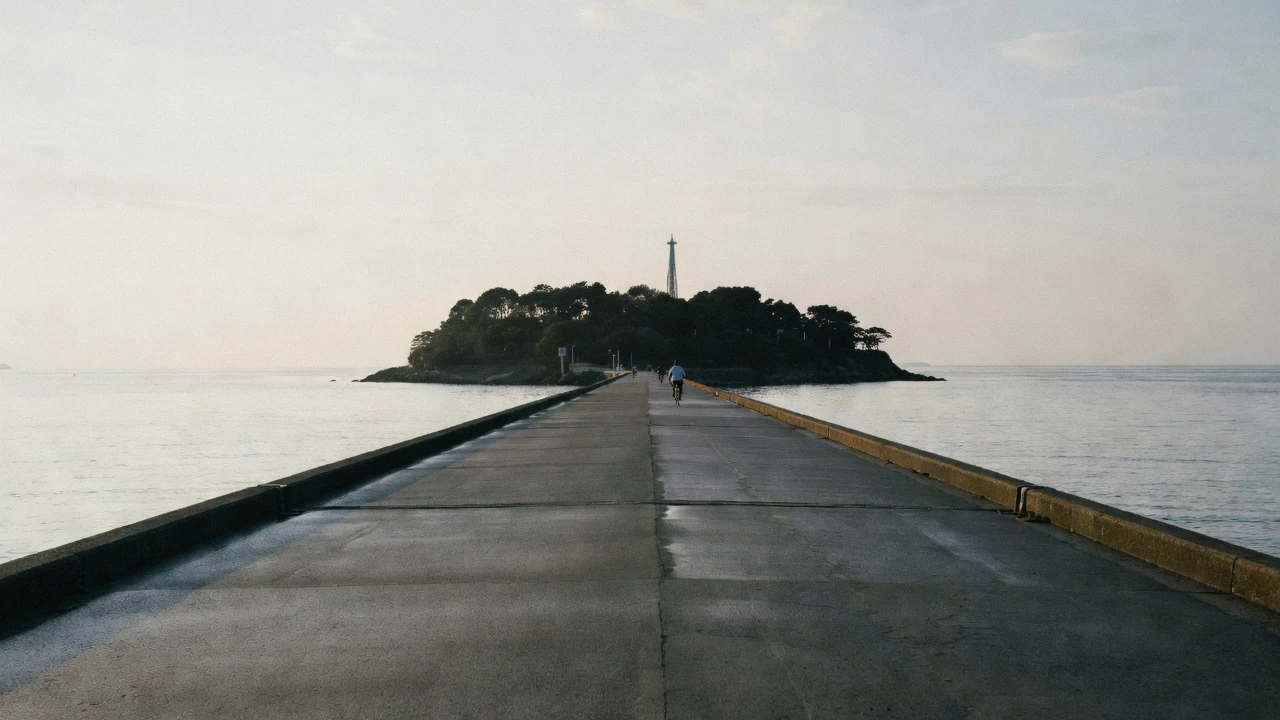
Enoshima Day Trip
An Enoshima day trip takes about an hour each way from Tokyo and lands you on a small hill of an island joined to the Shonan coast by a bridge, the rare outing you can walk end to end in an afternoon. The shape of the visit is fixed by geography: you cross the bridge at sea level, climb through a shrine and a shopping lane to a garden and a tower on the summit, then drop down the far side to a rock shelf and two sea caves at the waterline. Every one of those climbs can be paid away, which is what the escalators on the island are for. This page covers the entry prices, the tower and its set ticket, the caves, the boat back, the west-facing sunset over Mount Fuji and how the island pairs with Kamakura on a single day pass. The other destinations within two hours of the city are compared on the day trips hub, and the city itself is covered by what to do in Tokyo.
Quick answer What the island costs, how long it takes, when the boat runs
Enoshima costs nothing to visit. The bridge, the shrine and the shopping lane are free, and the only things with a price on them are the tower at $5.18 (¥800), the escalators at $3.24 (¥500) for all three sections, and the sea caves at the far end at $3.24 (¥500). Three hours walks the island; five does it justice.
Key takeaways
- Buy the set ticket at $7.13 (¥1,100) if you want the tower: it covers the garden, the tower and the escalators together, which is less than the parts bought separately.
- The island is on the same railway and the same day pass as Kamakura, which is why the 11-hour guided trip does both and lets you choose the second half.
- The far side faces west, which is the reason to stay past five: the rock shelf below the caves looks straight at Mount Fuji across the bay, weather permitting, and the odds on that mountain appearing are published.
- The small boat back to the bridge is $3.24 (¥500), cash only, and sails only when the sea is calm; the day's decision is made at about half past ten in the morning.
Key facts
Opening hours
| Samuel Cocking Garden and the tower, daily | 09:00–20:00 |
|---|---|
| Garden, free admission window | 09:00–17:00 |
| Iwaya sea caves, daily | 09:00–17:00 |
| Bentenmaru boat, weekends and holidays | 10:30–14:30 |
Closed None published for the island, the garden or the tower. The boat does not run on weekdays in January, February or December, and is cancelled outright in high wind, heavy swell or at low tide
Admission
- Adult
- Tower $5.18 (¥800); escalators, all three sections, $3.24 (¥500); sea caves $3.24 (¥500); set ticket for garden, tower and escalators $7.13 (¥1,100)
- Reduced
- Tower $2.59 (¥400) and caves $1.30 (¥200) for elementary-age children; set ticket $3.56 (¥550)
- Free
- The bridge, the shrine grounds, the shopping lane, the rock shelf at the far end, and the garden itself between 09:00 and 17:00 on days with no evening event
Planning it
- Time needed
- Not stated by any operator; our routing: 3 hours to walk the island properly, 5 to add the caves, the boat and a sunset
- Book ahead
- Optional — walk-up usually fine
- Address
- Enoshima 2, Fujisawa, Kanagawa 251-0036
The four things on Enoshima that charge admission, with the operators' own prices, read in Q3 2026 from the Sea Candle ticket page and the Fujisawa city tourism pages for the caves and the boat, converted at ¥1,000 to $6.48. The guided price is what GetYourGuide listed for that card on the same day. Nothing on the island is timed, and nothing needs booking ahead.
Are you here to walk the island, which is free, or to ride to the top of it and see the caves, which is where the money goes?
| Option | Price | How long | What it covers | Book |
|---|---|---|---|---|
| Set ticket: garden, tower and all three escalator sectionsAnyone who wants the view and would rather not climb the hill twice; it is cheaper than buying the tower and the escalators separately. | $7.13 (¥1,100) adult, $3.56 (¥550) child | About 90 minutes | The climb done for you, the Samuel Cocking Garden, and the observation deck at the top of the island | Official site |
| Iwaya sea caves, at the far end of the islandThe half of visitors who make it past the summit; this is the oldest thing on the island and the quietest. | $3.24 (¥500) general, $1.30 (¥200) elementary | 30 to 40 minutes | Two sea-cut caves, 152 and 56 metres deep, walked by candle lantern along a lit path | Official site |
| Bentenmaru, the small boat between the bridge and the far shoreAnyone with tired legs, or anyone who wants the caves first and the summit afterwards. It sails only in settled weather. | $3.24 (¥500) adult, $1.30 (¥200) child aged 6 and over; cash only | About 6 minutes | A shortcut to or from the caves that skips the climb entirely, plus the island seen from the water | Official site |
| Guided day trip from Tokyo with the coastal railway includedVisitors with one free day who want the island and a second destination without working out the transfers. | $53.93 | 11 hours | The island in the morning, then your choice of the temple town or the port city in the afternoon; 4.5 from 42 reviews | Check Availability |
The garden is free between 09:00 and 17:00 on ordinary days and charges $3.24 (¥500) after five only when an evening event is running, which it does for much of the year. If you are going up in the dark for the illuminations, check which ticket you need before you queue. All three official links above are plain and untracked.
Guided trips that include Enoshima
One card covers the island from Tokyo. The rating and review count are the platform's own figures as listed, and the price is what the operator showed then; the same operator's Kamakura-first trips are compared on the Kamakura page.
 from $53.93
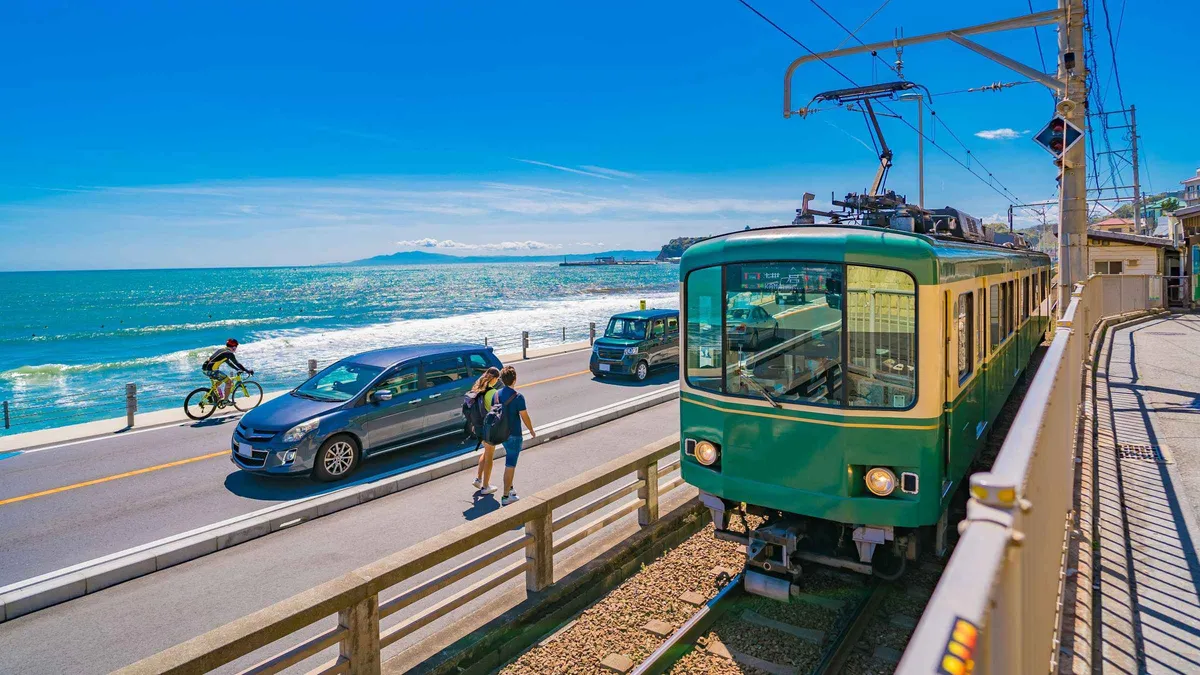
Tokyo: Enoshima, Kamakura or Yokohama Tour (Enoden Included)
An 11-hour day trip from Tokyo covering Enoshima with an Enoden train ride, then a choice of continuing to either Kamakura or Yokohama in the afternoon.
Check AvailabilityPrices, ratings and details are the platform's own. Dollar figures are the listed prices. The platform bills in your account's currency.
The Shape Of The Island, And Why It Matters
Enoshima is one hill in the sea, and everything about the visit follows from that. Distances and walking times below are ours, taken from the map and the gradients.
You arrive at sea level on the mainland side, cross the Benten Bridge on foot, and immediately start climbing. The lane up from the bridge is lined with shops selling grilled squid and shirasu, the whitebait the local boats bring in, and it ends at a bronze torii and the first of the shrine's halls.
From there the island keeps going up. The shrine occupies three separate sites on the slope, the Samuel Cocking Garden and the tower sit on the summit, and then the ground falls away steeply on the western side towards a rock shelf called Chigogafuchi and, at the waterline, the sea caves. That last descent is the one people underestimate: it is a long flight of steps down and the same steps back up, unless you take the boat.
The practical consequence is that Enoshima has an order. Bridge, shrine, summit, caves, then either the steps back or the boat, and the whole thing works better clockwise than in reverse. It is also why the paid escalators exist: three sections that lift you from the shrine to the summit, at $3.24 (¥500) for all three, which is the island's most honest tourist tax.
The Tower, The Garden And The Ticket Maze
The Sea Candle is the lighthouse-shaped observation tower on the summit, and it sits inside a botanical garden that has its own admission logic. Prices are the operator's own.
The straightforward version: the tower is $5.18 (¥800) for an adult and $2.59 (¥400) for a child, the garden is free from 09:00 to 17:00, and the whole site is open 09:00 to 20:00 with last entry at 19:30. The set ticket combining the garden, the tower and the three escalator sections is $7.13 (¥1,100) for an adult and $3.56 (¥550) for a child, and an annual pass is $9.72 (¥1,500).
| Ticket | Adult | Child | What it covers |
|---|---|---|---|
| Observation tower only | $5.18 (¥800) | $2.59 (¥400) | The deck at the top of the island; the garden around it is free by day |
| Escalators, three sections | $3.24 (¥500) | $1.62 (¥250) | Shrine level to the summit, one direction, no return leg |
| Set ticket: garden, tower, escalators | $7.13 (¥1,100) | $3.56 (¥550) | The usual buy, and cheaper than the parts |
| Set ticket plus evening entry | $10.04 (¥1,550) | $4.86 (¥750) | The same, valid after 17:00 during an evening event |
| Garden after 17:00, event days only | $3.24 (¥500) | $1.62 (¥250) | Nothing on ordinary days, when the garden is free all day |
The evening seasons, and when the garden stops being free
The garden charges after five o'clock only when an event is running, and the operator's own calendar shows those events covering most of the year: an art festival from early April to early June, lanterns from early August to mid-September, the Shonan Candle in October and early November, and the Shonan Jewel illumination from early December to the end of February. In practice, if you are going up for the lights, you are buying a ticket.
Payment is straightforward: cash, credit card, transport IC card or PayPay at the counters. The escalators are one-way, so the walk down is yours whichever ticket you hold.
The Sea Caves, And The Boat That Saves Your Legs
The Iwaya caves are the reason the island was a religious site at all, and they sit at the bottom of the far side. Prices, depths and hours are from the Fujisawa city tourism pages.
Two caves cut into the rock by the sea. The first runs 152 metres into the hill and was long said to connect to the ice caves at the foot of Mount Fuji; the second is 56 metres and carries the dragon legend that gives the island its founding story. Both are lit, and visitors are handed a candle lantern at the entrance, which is theatre but effective theatre.
Admission is $3.24 (¥500) for junior high age and above and $1.30 (¥200) for elementary children, with 20% off for groups of twenty or more and free entry, plus a companion, for holders of a disability certificate. Opening hours are 09:00 to 17:00 and vary by season, and the city tourism page points you at the day's actual hours rather than promising them.
The caves are old in a way the rest of the island is not. The city's own page records that Kobo Daishi and Nichiren are said to have practised here, and that in 1182 Minamoto no Yoritomo prayed at the caves before a campaign in the north, which is the same shogun whose capital sits twenty-five minutes up the coast.
Bentenmaru: six minutes that replace two hundred steps
A small passenger boat runs between the Benten Bridge and Chigogafuchi at the far end, taking about six minutes and costing $3.24 (¥500) for adults, $1.30 (¥200) for children aged six and over, and nothing for under-fives. It is cash only, and the ticket window shuts fifteen minutes before the last sailing.
The timetable is a forecast rather than a promise. Sailings run roughly 10:30 to 14:30 on weekends and holidays and roughly 11:00 to 14:30 on weekdays, with no weekday service at all in January, February and December, and the operator confirms whether the boat is running at about 10:30 each morning. High wind, heavy swell or a low tide cancels it mid-day as well as in advance.
Use it in one direction, not two. The sensible pattern is to walk the island over the top, see the caves, then take the boat back to the bridge with the island rising beside you; the reverse works too if the escalators are what you were dreading.
The Sunset, And The Mountain It Sets Behind
Enoshima's western side faces open water and, beyond it, Mount Fuji. That is the island's best hour and the one most day trips miss because the last train home is on their mind.
From the rock shelf at Chigogafuchi and from the deck of the tower, the view runs west across Sagami Bay with the mountain on the skyline. Nobody guarantees it. The City of Fuji's own long-running observation record puts full visibility of the mountain at 36.6% of morning checks and 22.5% by four in the afternoon, and while that count is taken from the far side of the mountain it tells you the direction of travel: clearest in the cold months, hazy in summer, worse as the day goes on. The Mount Fuji page sets out the whole record.
What this means practically is that a winter afternoon is the best bet for the silhouette, and that the island rewards staying late in a way the temple towns do not. The tower stays open until 20:00 with last entry at 19:30, the illuminations run for most of the year, and the walk back down the lane with the shops lit is a better end to the day than a rushed train.
One caution. The rock shelf is a natural platform washed by the sea, not a promenade, and it is closed or dangerous in rough weather. If the boat has been cancelled for swell, that is your signal about the shelf too.
Getting There, And The Pass That Covers Both Halves
Three railways reach the island's shore and one pass ties two of them together. Prices come from Odakyu's and Enoden's own pages.
Katase-Enoshima Station on the Odakyu Line puts you five minutes from the bridge; the Enoden station of the same name is a little further inland; and the Shonan Monorail arrives from Ofuna on the other side. From Shinjuku the Odakyu route takes about an hour to Fujisawa, and the local leg is short.
| Ticket | Price | Covers | When it pays |
|---|---|---|---|
| Enoshima-Kamakura Freepass from Shinjuku | $10.63 (¥1,640) adult, $2.79 (¥430) child | Odakyu round trip Shinjuku to Fujisawa plus unlimited coastal railway rides for one day | Any day that combines the island with the temple town |
| Enoshima-Kamakura Freepass from Fujisawa | $5.25 (¥810) adult, $2.66 (¥410) child | The local half only | If you arrive by JR at Fujisawa or Ofuna |
| Enoden one-day pass | $5.18 (¥800) adult, $2.59 (¥400) child | The whole coastal line all day, from any station machine | Three or more hops along the coast; it also carries a discount at the tower and the aquarium |
| Set ticket at the summit | $7.13 (¥1,100) | Garden, tower and escalators | Whenever you intend to go up at all |
| Guided day trip | $53.93 | Transport, guide and a second destination | One free day and no appetite for planning |
The gap in the freepass
Odakyu's own page states what its pass covers: the Odakyu round trip and unlimited rides on the coastal railway. The Shonan Monorail from Ofuna is not mentioned as included, so treat it as a separate fare, and the JR Yokosuka Line from Tokyo Station is a different company again. If your day starts at Tokyo or Shinagawa rather than Shinjuku, the cleaner buy is a JR ticket to Fujisawa or Kamakura and the Enoden day pass at the machine. Getting around explains the IC cards that make the difference small.
Enoshima In Seven Dates
A hill in the sea that has been a pilgrimage site, a botanical experiment and an Olympic harbour, in that order.
-
552
The island's founding legend is dated
The shrine's traditional account places the enshrinement of the goddess Benzaiten in the sea caves in the sixth century, which is why the caves rather than the summit are the old sacred ground [Fujisawa city tourism, Iwaya cave page].
-
Ninth century onward
Kobo Daishi and later Nichiren are said to practise in the caves
The city's own page records both traditions; the caves were an ascetic site long before they were a ticketed attraction [Fujisawa city tourism, Iwaya cave page].
-
1182
Minamoto no Yoritomo prays here before a campaign
The first Kamakura shogun is recorded as praying at the caves ahead of the northern campaign against the Fujiwara, tying the island to the capital up the coast [Fujisawa city tourism, Iwaya cave page].
-
1880s
Samuel Cocking builds a garden on the summit
The British merchant's botanical garden, with a heated greenhouse, is the reason the top of the island is laid out the way it is; the modern garden carries his name [Wikipedia, Enoshima].
-
1902
The coastal railway reaches the shore
The Enoden opens along the Shonan coast, turning a pilgrimage into a day trip from the capital [Wikipedia, Enoshima Electric Railway].
-
1964
The Olympic sailing harbour is built
Tokyo's first Games put a yacht harbour on the island's eastern side, which is still working and which the walk from the bridge passes [Wikipedia, Enoshima].
-
2021
Olympic sailing returns to the same water
The rescheduled Tokyo Games ran their sailing events off Enoshima again, half a century after the first [Wikipedia, Enoshima].
Prices, hours and the cave depths on this page come from enoshima-seacandle.com and the Fujisawa city tourism pages. The Enoshima Shrine's own website could not be read: its domain served an invalid security certificate to our fetch tool on the day we checked, so this page prints no admission figure or hours for the shrine's inner hall rather than borrowing one. The historical dates are from the Wikipedia article on the island, which we name rather than dress up as archive work.
How Much Time To Give Enoshima
No operator publishes a suggested visit length. These three routings are ours, built from the gradients, the opening hours above and the boat timetable.
The island is small enough that the question is not what to see but how much climbing you are prepared to do and whether you stay for the light.
| Routing | What you get | What it skips | Door to door |
|---|---|---|---|
| The short walk | Bridge, shopping lane, the shrine's first hall, back over the bridge | The summit, the tower, the caves and the west side entirely | About 4 hours from central Tokyo and back, of which 2 is travel |
| The full island | Escalators or steps to the summit, garden and tower, down the far side, the caves, the boat back | Nothing on the island; you will not also fit the temple town | 7 to 8 hours |
| Island plus a second stop | The guided version pairs the island with either the temple town or the port city, with the coastal railway included | The evening light here, since the group leaves in the afternoon | 11 hours, fixed |
Five Things Most Visitors Do Not Know About Enoshima
Each changes a decision you would otherwise make on the bridge, and each carries its source.
- The escalators are one way only. All three sections carry you up from the shrine to the summit for $3.24 (¥500); there is no descent, so the walk down is yours no matter what you paid [enoshima-seacandle.com ticket page]. - The garden is free by day and charges only when there is an evening event. Between 09:00 and 17:00 it costs nothing, and the after-five charge of $3.24 (¥500) applies on event days, which cover most of the calendar [enoshima-seacandle.com ticket page]. - The first cave runs 152 metres into the hill. The second is 56 metres, and the old story has the first one connecting to the ice caves at the foot of Mount Fuji [Fujisawa city tourism, Iwaya cave page]. - The boat decides each morning whether it is sailing. Bentenmaru confirms the day's service at about 10:30 and does not run on weekdays in January, February or December; it is cash only [Fujisawa city tourism, Bentenmaru page]. - The shrine has no readable website. The domain that should carry the shrine's own hours served an invalid certificate when we tried it, which is why every figure on this page comes from the tower operator or the city instead. An island day like this one usually fits into a longer stay in the capital, so it is worth browsing a tokyo tour comparison to see how guided tours in tokyo and the best tokyo tours slot around it.
On Enoshima: What To Do, And What Not To
Each line is a decision argued above, in the form you can act on at the bridge.
Do
- Walk the island clockwise: bridge, shrine, summit, caves, then the boat back
- Buy the $7.13 (¥1,100) set ticket if the tower is on your list, rather than the tower and escalators separately
- Carry cash for the boat, which takes nothing else
- Check whether the boat is sailing before you commit to the far end, since the call is made at about 10:30
- Stay for the light if the sky is clear, because the west side looks at Mount Fuji and the tower is open until 20:00
- Pair it with Kamakura on one day pass if you have a full day rather than an afternoon
Don't
- Don't assume the escalators bring you back down, because they do not
- Don't pay the after-five garden charge without checking whether an event is actually on
- Don't plan the rock shelf in rough weather; if the boat is cancelled for swell, the shelf is not the place to be
- Don't count on weekday sailings in January, February or December, when there are none
- Don't skip the caves because of the steps; that is what the boat is for
- Don't leave the island for last on a short trip, since the crossing from Tokyo eats two hours whichever route you take
Enoshima map: the bridge, the summit and the caves
The island end to end, with the stations on the mainland side and the two ways down to the caves. Positions are read at street level and are good enough to walk by.
Coordinates for the island are the ones recorded on its Wikidata item, Q989803; the rest are read off the map and rounded.
What pairs with the island
Travel times are the operators' own; the judgement is ours.
Kamakura
Temples, a bronze Buddha and a shrine, on the same day pass and the same little train. The 11-hour guided trip offers it as the afternoon option.
About 25 minutes east on the coastal railwayYokohama
The other half of the guided trip, and a good evening if the island's weather turns: a waterfront, a Chinatown and museums that do not care about the sky.
Under an hour northThe rest of the day trips
Every destination within two hours, compared on travel time, cost and bad-weather behaviour, including Mount Fuji, whose silhouette is the thing you are hoping to see from this island's western shore.
One to two hours outEnoshima questions
Is Enoshima worth a day out from Tokyo?
Yes, if you want a coastline rather than another temple district, and especially if you can stay for the evening. It is about an hour each way, the island itself costs nothing to walk, and the paid parts come to under twenty dollars for two people. What it is not is a full day on its own for most visitors, which is why almost everybody pairs it with Kamakura on one pass.
How much time do you need on the island?
Three hours walks it properly: bridge, shrine, summit and back. Five hours adds the caves at the far end, the boat and time to sit. Four hours is the version most guided trips allow, which is enough for everything except the sunset. Our three routings set out what each one skips.
What does the observation tower cost, and is the garden free?
The tower is $5.18 (¥800) for an adult and $2.59 (¥400) for a child. The garden around it is free between 09:00 and 17:00 and charges $3.24 (¥500) after five only on days when an evening event is running, which covers much of the year. The set ticket at $7.13 (¥1,100) bundles the garden, the tower and the escalators and is the usual buy.
Are the escalators worth paying for?
If your knees prefer it, yes, but know what you are buying: $3.24 (¥500) covers all three sections in the upward direction only. There is no descent, so you walk down whichever ticket you hold. Anyone who would rather skip the climb altogether can take the small boat to the far end and see the caves first, then come up the hill in one direction only.
What are the sea caves, and how much do they cost?
Two caves cut by the sea at the foot of the western cliffs, the first running 152 metres into the rock and the second 56, walked with a candle lantern along a lit path. Admission is $3.24 (¥500) for junior high age and above and $1.30 (¥200) for elementary children, and hours are 09:00 to 17:00 with seasonal variation. They are the oldest sacred ground here, older than anything on the summit.
Can you see Mount Fuji from here?
On a clear day, yes, straight across the bay from the western side and from the tower deck. Nobody guarantees it: the long-running official observation record on the mountain's own side puts full visibility at 36.6% of morning checks, falling through the day, and it is worst in summer. Winter afternoons are the reliable bet, and the full record is on the Mount Fuji page.
When does the little boat around the island run?
Roughly 10:30 to 14:30 on weekends and holidays and roughly 11:00 to 14:30 on weekdays, with no weekday sailings in January, February or December. The operator confirms the day's service at about 10:30 each morning and cancels for wind, swell or low tide. It costs $3.24 (¥500) for adults, is cash only, and the ticket window shuts fifteen minutes before the last sailing.
Which pass covers the island and the temples on the same day?
The Odakyu Enoshima-Kamakura Freepass, at $10.63 (¥1,640) from Shinjuku, covering the round trip and unlimited rides on the coastal railway. If you travel out on JR instead, buy the Enoden one-day pass for $5.18 (¥800) at any station machine; it also carries a discount at the tower here. The full comparison is above.
Where the island fits in a Tokyo trip
It is the coast day, and it is the one that improves the later you stay, which makes it a poor morning and an excellent afternoon.
The pattern that works on a full day is temples first and island second: an early train to Kamakura, the shrine and the two temples at Hase before lunch, then the coastal railway west in the afternoon and the island for the last of the light. One pass covers all of it, and the day ends looking west rather than queuing for a train back from a shopping street.
On a half day, do the reverse and keep it small. Arrive after lunch, walk the lane, take the escalators up, look at the water and go home. That version costs about ten dollars on the island and still feels like leaving the city, which is the whole point of a coast day. If your trip has only one spare day and the forecast is poor, Yokohama is closer and mostly indoors.
Enoshima On Film: The Bridge, The Summit and The Caves
Three walk-throughs that show the climb, the escalators and the far side of the island, which is the part the photographs never explain properly.
Enoshima Island: A Refreshing Day Trip from Tokyo
Walks the island in the order this page recommends, from the bridge to the caves.
Video: Tokyo CheapoEasy Day Trip from Tokyo, Enoshima & Kamakura
Covers the pairing with the temple town, and the railway that links them.
Video: Japan GuideBeachside Escape From Tokyo | Enoshima Island Food, Shrines & Views
Spends time on the shopping lane and the food, which is half of what the climb up is actually like.
Video: Travel Smart JapanVideos load from YouTube only when you press play.
Prices, hours and terms are set by the venue or operator and confirmed at checkout.
We may earn a commission if you book through one of our links, at no extra cost to you. Full affiliate disclosure