 Visit Tokyo Guide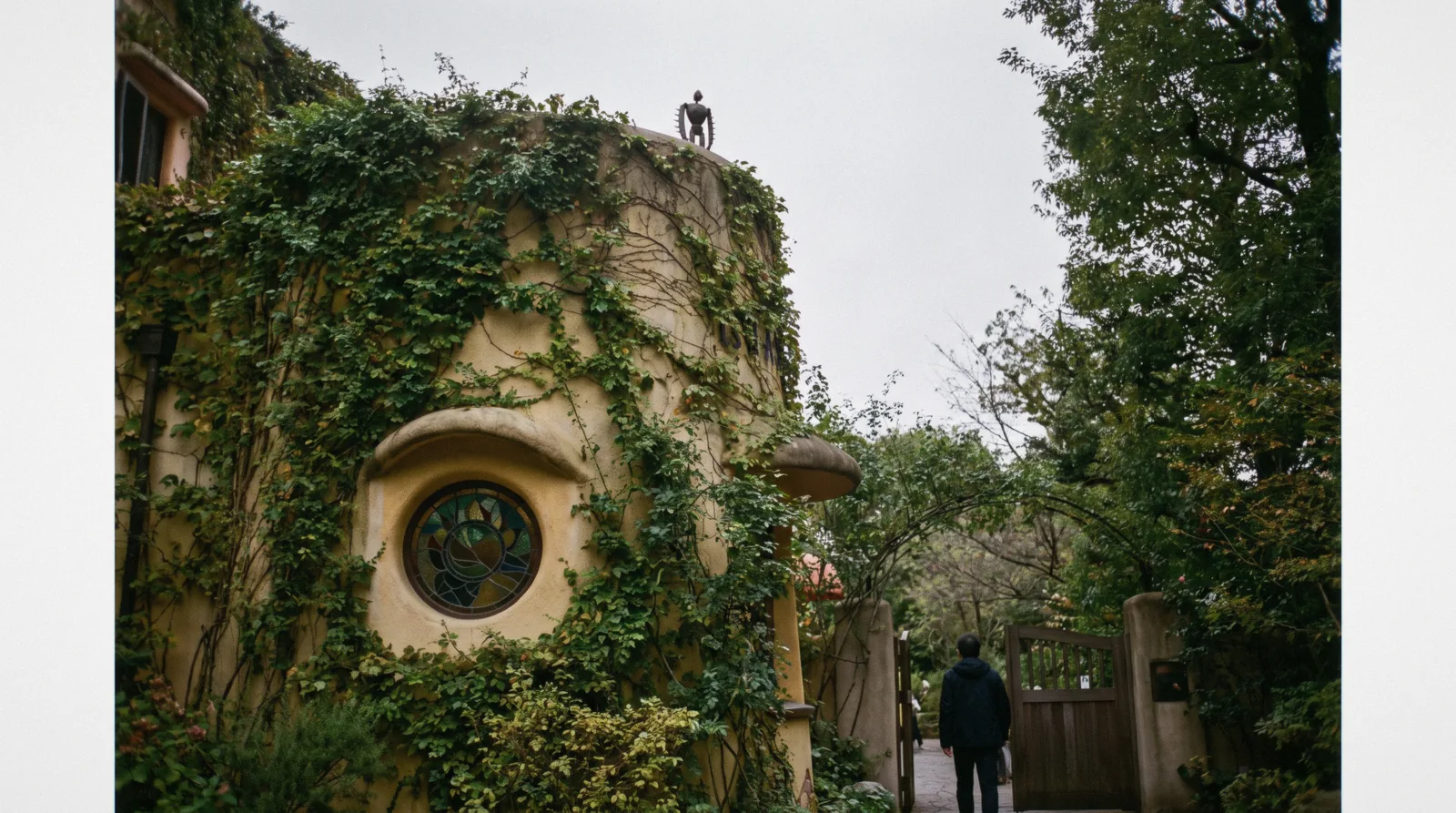
Ghibli Museum, Mitaka
The Ghibli Museum is a small three-storey building at the edge of Inokashira Park in Mitaka, west of central Tokyo, designed by Hayao Miyazaki himself and opened in 2001. It is not a gallery of film props behind glass. The building is the exhibit, photography inside is forbidden, and every visitor sees one short Studio Ghibli film that is screened nowhere else. This page covers what is inside, the hours, the Tuesday closures and the walk from Mitaka Station; the sale window, the Lawson account and what to do when your month is gone all sit on the Ghibli Museum tickets page. For the rest of the city plan, see things to do in Tokyo.
Quick answer Hours, price, what is inside, how long, in three lines
The Ghibli Museum opens 10:00 to 18:00 and closes most Tuesdays, not Mondays. Entry is $6.48 (¥1,000) for adults, timed, name-printed, and sold only in advance: nothing at all is sold at the door.
Key takeaways
- Once you are inside there is no exit time, so a 10:00 slot and a 16:00 slot buy very different visits; the sale window and the account rules decide which one you get
- A guided visit with the ticket included costs about ten times the museum's own admission, which is what paying somebody to solve the booking problem costs
- You see one short film in the Saturn Theater and it rotates monthly, so what is showing is worth checking before you fix a date; photography is banned everywhere indoors
Key facts
Opening hours
| All year, Wednesday to Monday | 10:00–18:00 |
|---|---|
| Entry window | Within one hour of the time printed on the ticket; no set exit time |
Closed Most Tuesdays, though not all: 11 August and 22 September 2026 stay open. Also closed 4 to 18 November 2026 and 27 December 2026 to 2 January 2027. On 1 and 3 October 2026 there is no general sale because those are Mitaka residents' days.
Admission
- Adult
- $6.48 (¥1,000), ages 19 and over
- Reduced
- $4.54 (¥700) ages 13 to 18; $2.59 (¥400) ages 7 to 12; $0.65 (¥100) ages 4 to 6
- Free
- Ages 3 and under
Planning it
- Time needed
- Not stated by the museum, and there is no exit time. Our routing: two hours for the building, the film and the roof; three if you sit in the café
- Book ahead
- Essential — weeks ahead
- Address
- 1-1-83 Shimorenjaku, Mitaka-shi, Tokyo 181-0013
Three ways in, read on ghibli-museum.jp and on the GetYourGuide cards in Q3 2026. The museum's own ticket is the cheapest by a wide margin and the hardest to get; the guided cards cost more because the booking, not the building, is what they solve. The full buying mechanics live on the tickets page.
Are you buying admission, or are you paying somebody else to win the ticket window for you?
| Option | Price | Includes | Sold when | Book |
|---|---|---|---|---|
| Official timed ticket, sold through Lawson TicketAnyone who can be awake and online at 10:00 Japan time on the tenth of the month before the visit | $6.48 (¥1,000) adult, $2.59 (¥400) ages 7 to 12 | Timed entry, every exhibit, one short film in the Saturn Theater | From 10:00 JST on the 10th of the previous month, until the slot fills | Official site |
| Guided Ghibli Museum visit with the ticket includedVisitors who would rather pay the difference than gamble on a sale window in a foreign time zone | $64.93 as listed | Museum entry plus a guide who explains the exhibits | On the operator's own calendar, not the museum's | Check Availability |
| Studio Ghibli origins walking tour, three hoursPeople who missed the museum entirely and still want the Ghibli day out | $83.11 as listed | Tokyo places tied to the studio's history, plus a Ghibli-themed sweet | On the operator's own calendar | Check Availability |
The gap is the point. The museum charges $6.48 (¥1,000) and refuses to sell at the door; the guided card is listed at $64.93. You are not buying a better ticket, you are buying somebody else's place in a queue that opens once a month. Prices are the operators' listed dollar figures.
Ghibli Museum visits compared
Two cards, both with dated availability on the operator's own calendar, which is the part the museum's own shop does not give you. Prices are the operators' listed US dollar figures.
 from $64.93
Tokyo: Ghibli Museum Mitaka Tour with Local Guide & Ticket
A 1.5-hour guided visit to the Ghibli Museum with a local guide handling the notoriously hard-to-get ticket reservation. Non-refundable once booked; reviewers rate the value for money lower than the guiding itself.
Check Availability from $83.11
Tokyo: Studio Ghibli Origins Walking Tour
A 3-hour small-group walk through Kichijoji and nearby neighborhoods tied to Studio Ghibli's history and Spirited Away, with a sweet treat included. Museum entry is not part of this tour.
Check AvailabilityPrices, ratings and details are the platform's own. Dollar figures are the listed prices. The platform bills in your account's currency.
What the Ghibli Museum actually is
The single most common disappointment here comes from expecting a Studio Ghibli theme park. It is a museum about how animation is made, in a building that behaves like one of Miyazaki's drawings.
Planning began in 1998, construction in March 2000, and the museum opened on 1 October 2001. Miyazaki designed it himself using storyboards, the same way he designs a film, and took the hilltop village of Calcata in Italy as one of his references. What that produces is a building with iron spiral staircases inside and out, interior bridges, balconies at odd heights and stairways that lead to exhibits, to other stairways, and sometimes to nothing at all.
The dead ends are deliberate. His stated aim was for the building itself to be part of the exhibit and for the visit to be, in his words, an experience "that makes you feel more enriched when you leave than when you entered". The museum's slogan, "Let's get lost together", is the instruction, not the marketing.
Practically, that means there is no route. Staff do not herd anyone, there is no numbered circuit, and no audio guide walks you through in order. You are handed a ticket that is also a strip of real 35 mm film, you walk in through a ceiling fresco of Ghibli characters, and from there the building is yours until closing time.
Visitors who want a checklist find this frustrating. Visitors who like buildings find it the best two hours in west Tokyo.
It is also small. Three floors plus a basement theatre and a roof garden, on a plot inside a public park. Compare that with the scale of the Tokyo National Museum in Ueno and you will set your expectations correctly: this is a couple of hours in a jewel box, not a museum day.
The Ghibli Museum In Eight Dates
Every date below is argued somewhere on this page; the list is here so the building reads in order rather than in themes.
-
1998
Planning begins
Studio Ghibli starts work on a museum of its own in Mitaka, the western Tokyo city whose name means three hawks.
-
March 2000
Construction starts
On a corner of Inokashira Park, land owned by the city of Mitaka.
-
1 October 2001
The museum opens
Miyazaki designed the building himself from storyboards, with spiral staircases, interior bridges and stairways that lead to dead ends.
-
6 February 2002
Tri Hawks opens
The reading room and bookshop, filled with books Miyazaki recommends. The name is a translation of Mitaka.
-
2005
The museum is filmed for its own DVD
Isao Takahata and Goro Miyazaki record the building and its making for a Japanese release about the museum and its designer.
-
February 2020
Closed by the pandemic
The first long closure in the museum's history.
-
July 2020
Reopens to Mitaka residents only
The city's own residents got the building back first, which is the origin of the residents' days that still take entire dates off the public sale calendar.
-
September 2020
Reopens to everyone, by reservation
The advance-only, timed, name-printed ticket that governs a visit today dates from this reopening rather than from 2001.
Dates from the Ghibli Museum's own pages at ghibli-museum.jp and the museum's Wikipedia entry. The residents'-day link between 2020 and the current calendar is our reading of the two published facts, not a museum statement.
What to see inside: the six things that decide your route
There is no official highlights list, because the museum does not think in highlights. These are the six spaces people actually talk about afterwards, in the order most visitors reach them.
The permanent exhibition, "Where a Film is Born"
The basement room covers the history and science of animation, including a three-dimensional zoetrope of My Neighbor Totoro figures that spins under a strobe until the models appear to move. Anyone sensitive to flashing light should know that exhibit is in there before they walk in; the museum says so on its own accessibility page. Upstairs on the first floor is a five-room mock-up of an animation studio, walls covered in sketches, desks buried in books and reference, storyboards pinned where an artist would actually pin them.
It is the room that changes how people watch the films afterwards.
The Saturn Theater, in the basement
A small cinema with windows whose shades lower before a screening and open again afterwards, because Miyazaki designed it for small children who might be frightened by a fully dark room. Your ticket admits you once. The film is a Studio Ghibli short shown nowhere else in Tokyo, and it changes: the museum publishes the current title on its front page, and Lawson's schedule listed Mr. Dough and the Egg Princess through September 2026 and The Whale Hunt from 1 to 31 October 2026.
Wikipedia's catalogue lists ten shorts in the rotation, among them Mei and the Kittenbus, Water Spider Monmon, Boro the Caterpillar and A Sumo Wrestler's Tail.
The Catbus room
A playroom with a soft Catbus built slightly under the scale it has in My Neighbor Totoro, so that it fits the building. Children aged 12 and under may climb in. Adults may not, and this is the single most common complaint from adult fans, so it is worth knowing before the ticket is bought rather than at the door of the room.
The roof garden and the Robot Soldier
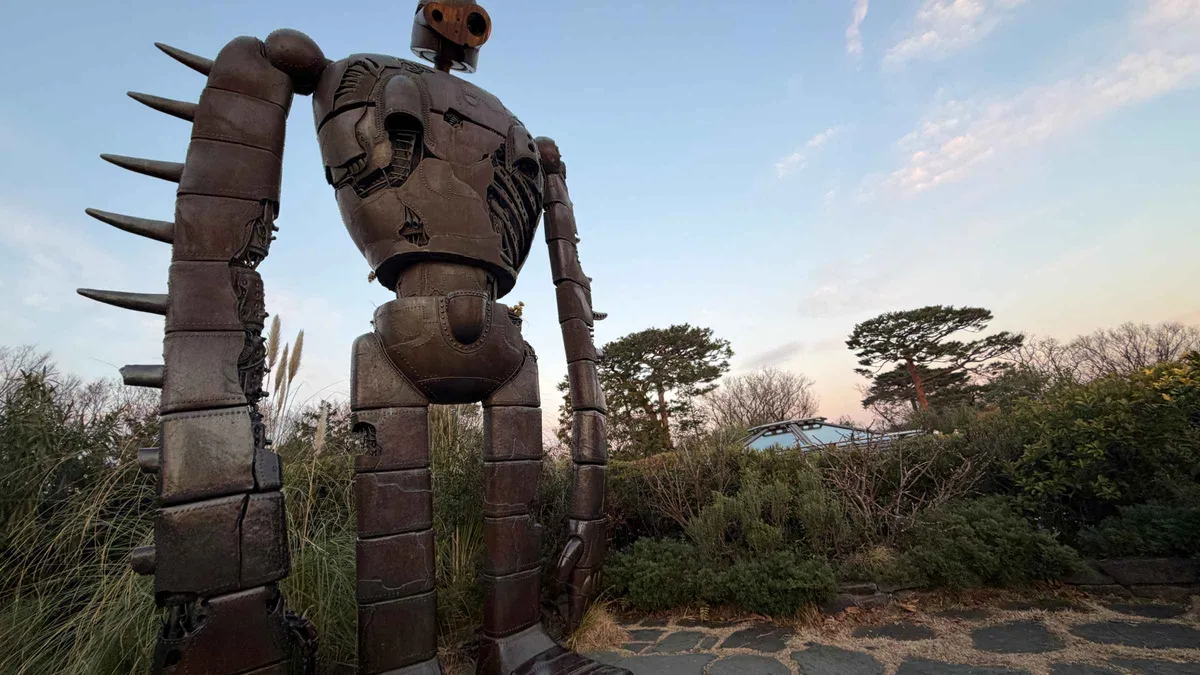
A five-metre robot from Castle in the Sky stands in the roof garden, hammered from copper plate by the artist Kunio Shachimaru over two years. The Laputa keystone with its Old Persian cuneiform inscription is up there too. Two things to plan for: the roof is reached only by a narrow circular staircase, with no lift from the second floor, and the museum closes the garden in bad weather.
The special exhibition room
One exhibition at a time, changed roughly once a year, and not always about Ghibli: the museum has shown work from other studios, including Miyazaki's and Takahata's pre-Ghibli Panda! Go, Panda! from 1972. The exhibition running when we checked was "The Studio of Yuriko Yamawaki, Treasure from an Artist's Clutter", listed by Lawson as running from 19 November 2025 until some point in 2027.
The stained glass and the fresco
Easy to walk past. Characters appear in stained glass throughout the building, including the lesser-known blue Chu Totoros, and the entrance ceiling carries a fresco with Kiki on her broomstick. Photography is not allowed for either, which is precisely why people remember them.
How Much Time To Give The Ghibli Museum
The museum publishes no visit length and sets no exit time, which is unusual and useful: your ticket buys the rest of the day inside if you want it. These three routings are ours, built from the floor plan, the film schedule and the walk to the station.
The variable is not the exhibits, it is whether you sit down. A visitor who walks the three floors, watches the film and climbs to the roof is out in about ninety minutes. A visitor who queues for the Straw Hat Café adds an hour to that, and a visitor who arrives on the last slot of the day gets neither, because the café and the shop close with the building at 18:00.
| Routing | What you get | What it skips | Door to door |
|---|---|---|---|
| The short visit | All three floors, the permanent exhibition, the film in the Saturn Theater, the roof | The café queue, the reading room, a second look at the animation studio rooms | About 1 h 30 inside, plus 15 minutes on foot each way from Mitaka Station |
| The full visit | The same, plus the Straw Hat Café, Tri Hawks and time to work out where the staircases go | Nothing, but the last hour is attention many visitors no longer have | Three hours inside; with the walk and the train from Shinjuku, half a day |
| With a guide | The guided visit at $64.93 hands you the ticket and the explanation, which is the whole problem solved | The unstructured wandering the building was designed around | Set by the operator; budget a half day from central Tokyo either way |
One planning consequence worth spelling out: because there is no exit time, the cheapest way to get a long visit is the earliest slot, and the fastest way to waste the ticket is a 16:00 slot on a day when you also wanted the café. If the ticket window only leaves you a late slot, take it and skip the café rather than skipping the museum.
Hours, the Tuesday closures and the weeks the museum shuts
The museum publishes 10:00 to 18:00 and then publishes a calendar of closed dates rather than a closed weekday, which catches people out. We counted the shaded dates on the museum's own ticket calendar; here is what the pattern actually is.
Tuesday is the usual closing day, and Monday is not. That is the opposite of the pattern at Tokyo's state and metropolitan museums, and it makes the Ghibli Museum one of the few serious museum options on a Tokyo Monday, alongside the rest of the Monday openings list. But it is not every Tuesday.
On the calendar we read, 11 August and 22 September 2026 are both Tuesdays and both open, sitting inside Japanese holiday weeks.
| Closure | Dates on the published calendar | What it means for a visit |
|---|---|---|
| Ordinary weekly closure | Most Tuesdays, all year | Do not build a Tuesday around it without checking that month's calendar |
| Tuesdays that stay open | 11 August 2026, 22 September 2026 | Holiday-week exceptions; the sale still runs on the normal monthly schedule |
| Autumn maintenance | 4 to 18 November 2026 | A fortnight with no admission at all, and no reason published |
| Year end and new year | 27 December 2026 to 2 January 2027 | Seven consecutive days closed over the busiest travel week of the Japanese year |
| Mitaka residents' days | 1 and 3 October 2026 | The museum is open but there is no general sale, per Lawson's own notice |
Two negative findings worth stating plainly. First, the museum publishes no reason for the November fortnight or the year-end block, so anyone telling you it is an exhibition changeover is guessing. Second, the museum publishes no last-admission time separate from closing: what it publishes instead is the entry window on the ticket itself, which is one hour from the time printed on it.
Arrive more than an hour late and you are relying on the goodwill of the staff at the gate, with a rule in writing that says otherwise.
The no-photography rule, and what it changes
This is the rule visitors break most often and the one the museum is most consistent about.
Photography and video are prohibited anywhere inside the building. The museum's own visitor policies also ask you to switch your phone off indoors rather than silence it, ban eating and drinking outside the café and its terrace, ban smoking entirely and admit no pets except service dogs. The reason given for the camera ban is not commercial: the museum describes itself as a "portal to a storybook world" and takes the position that looking through a screen is not being in it.
In practice the ban is why the outdoor spaces are crowded with cameras. The roof garden and the Robot Soldier are outdoors, and photography there is what fills the internet with Ghibli Museum pictures while the interior stays largely unphotographed. If a photograph matters to your trip, plan for the roof and accept the rest as an unrecorded ninety minutes.
If you are travelling with someone who needs to document everything, this is the museum where that will cause an argument, and it is better had before you buy.
One consequence people miss: because nothing inside is photographed, almost every image you have seen of the interior is either official, taken before the current policy, or taken somewhere else entirely. Set expectations from the museum's own site rather than from image search.
Eating, reading and shopping on site
Three named places, all inside the ticket, all with the same closing time as the building. Prices are not published by the museum, so nothing below carries a figure we have not read.
The Straw Hat Café is the only sit-down restaurant, built with the help of a housewife and mother of four because Miyazaki wanted the food to be "a kind of home cooking" rather than museum catering. It serves hot and cold dishes, snacks and desserts, and its takeout window sells an own-label beer called "Valley of the Wind", made with the Oratche microbrewery in the Tanna basin and labelled with a drawing by Goro Miyazaki. The café queue is the main reason a two-hour visit becomes three.
Tri Hawks, opened on 6 February 2002, is the reading room and bookshop, stocked with books Miyazaki recommends rather than with merchandise. Mamma Aiuto on the top floor is the souvenir shop, named for the sky pirates in Porco Rosso; the name means "mama, help me" in Italian. It sells, among other things, non-Japanese animated films under the Ghibli Museum Library label, which is the one souvenir here you genuinely cannot buy in Shibuya.
Payment: the café, the shop and the reading room take Japanese yen in cash and also JCB, Visa, Mastercard, American Express, Diners Club and UnionPay, plus the usual Japanese electronic money including Suica, iD, nanaco, WAON and Edy. That is worth knowing because the cash question in Tokyo is answered differently in different places, and this museum answers it generously.
Five Things Most Visitors Do Not Know About The Ghibli Museum
All five come off the museum's own pages or the official ticket agent, and each changes something practical about the visit.
- There is no exit time. The ticket fixes when you may enter, within one hour of the printed time, and then nothing at all. The museum runs no swap-out system, so a 10:00 ticket can legitimately be an eight-hour visit [Lawson Ticket's Ghibli Museum admission notes, l-tike.com/ghibli]. - Tuesday, not Monday, is the closing day, and not every Tuesday. The official calendar leaves 11 August and 22 September 2026 open while shading almost every other Tuesday of the year [the museum's ticket calendar at ghibli-museum.jp]. - Wheelchairs are lent free and the whole building except the roof is accessible. Four unisex accessible toilets sit inside the main building, with a nursing room, changing tables and an ostomate facility on B1F; the roof garden is the one space the lift does not reach [ghibli-museum.jp accessibility page]. - Hearing assistance earphones exist for the Saturn Theater, in Japanese only. That is the museum's own wording, and it is the clearest statement anywhere on its site that the film is not subtitled for you [ghibli-museum.jp accessibility page]. - The lockers are free, with a refundable deposit, and the museum explicitly asks you to use them because objects dropped from the interior bridges and balconies have caused injuries below [ghibli-museum.jp visitor policies]. Getting the ticket, the closing Tuesdays and the lift-free roof sorted is fiddly enough on its own, so pairing the visit with the best tokyo tours is an easy way to keep the rest of the day simple best tokyo tours.
How to get there: Mitaka Station, the walk and the yellow bus
The museum is in Mitaka, about 20 minutes west of Shinjuku on the JR Chuo Line, and there are exactly two sensible ways to cover the last kilometre. Fares below are the operator's published figures, converted at the site rate.
Take the JR Chuo Line to Mitaka Station, which the museum puts at about 20 minutes from Shinjuku. Leave by the south exit. From there it is a 15-minute walk, signposted, along a canal path that is pleasant in every season and shadeless in August.
The alternative is the community shuttle bus, which runs from Mitaka Station every 15 minutes during opening hours and is the reason nobody with a pushchair walks.
| Way in | Fare | Time | Worth it when |
|---|---|---|---|
| Walk from Mitaka south exit | Free | 15 minutes | Any dry day; the canal path is part of the visit |
| Community bus, adult | $1.49 (¥230) cash or IC card | Every 15 minutes during opening hours | Rain, August heat, tight slot times |
| Community bus, child aged 7 to 12 | $0.78 (¥120) cash, $0.32 (¥50) by IC card | Same service | Note the IC card fare is under half the cash fare |
| Walk from Kichijoji Station | Free | About 20 minutes through Inokashira Park | When you want the park before the museum, not after |
The Kichijoji approach is the one the museum mentions without timing it, and it is our preferred route: you walk in through Inokashira Park rather than along a canal, and you arrive at a museum that sits inside a park instead of at the end of a suburban street. The museum states no walking time for it, so treat about 20 minutes as our estimate from the mapped distance, not an official figure.
There is no visitor parking at all, and the museum asks people to come by public transport. If you are working out passes and IC cards for the rest of the week, getting around Tokyo covers what the Chuo Line ride actually costs and whether a pass earns its price.
At The Ghibli Museum: What To Do, And What Not To
Every line here is a decision argued somewhere above, compressed into the form you can act on that morning.
Do
- Take the earliest slot the sale gives you; with no exit time, an early ticket is simply a longer museum
- Carry the ID that matches the name on the ticket, because the gate is entitled to check it
- Put bags in the free lockers before you climb, since the museum asks you to and the balconies are open
- Walk in from Kichijoji through Inokashira Park if the weather is good, and take the bus at $1.49 (¥230) back if it is not
- Check which short film is running before you fix the date, because it rotates monthly and you only see one
Don't
- Don't plan a Tuesday without opening that month's calendar, and don't assume the Monday rule that governs most Tokyo museums applies here
- Don't turn up expecting to buy at the door; there is no ticket desk at the museum, at any price
- Don't promise an adult a ride in the Catbus, which is for children aged 12 and under
- Don't plan the roof garden as the reason for the trip, because it closes in bad weather and the only way up is a narrow spiral staircase
- Don't photograph indoors, and don't expect a warning shot; the ban covers video too
Ghibli Museum map: the two stations and the park
The museum, the two stations that reach it and the park it sits inside. Museum coordinates from its Wikidata record; the station and park pins are geocoded from OpenStreetMap.
Pin positions: the museum from Wikidata Q947907, the rest geocoded from OpenStreetMap.
Next stop from the Ghibli Museum
Walking times are our estimates from the mapped distances, except the 15 minutes from Mitaka Station, which is the museum's own figure.
Inokashira Park
The museum stands on a corner of the park, so the obvious move after a ninety-minute visit is to walk out into it. Swan boats on the pond, a shrine on an island, cherry trees that make this one of the busiest hanami spots in west Tokyo, and no admission of any kind. It is also the answer on a day when the ticket sale defeated you: the park is free and open whatever the museum calendar says.
At the gateKichijoji
Walk the park end to end and you arrive in Kichijoji, a residential neighbourhood with a covered shopping street, second-hand bookshops and the kind of standing bars that central Tokyo prices out. It is the natural lunch and evening half of a museum morning, and it sits on the same Chuo Line ride home. Where it fits among the city's other districts is on the neighbourhoods hub.
About 20 minutes through the parkShinjuku
The museum puts Mitaka at about 20 minutes from Shinjuku, which means the Ghibli Museum is a half-day off the side of a Shinjuku base rather than an expedition. Trains run all day, so a 10:00 slot still leaves the whole afternoon in the city; what Shinjuku is actually for covers where to spend it.
About 20 minutes by JR Chuo LineGhibli Museum questions
Is the Ghibli Museum worth going to?
If you want to see how animation is made, inside a building designed by the man who made the films, yes, and at $6.48 (¥1,000) it is among the cheapest serious museums in Tokyo. If you are hoping for rides, character meet-and-greets or a photo of yourself with Totoro, it is not: this is three small floors, no photography and one short film. The guided visit with entry included is the version to buy if the difficulty of the ticket is what is stopping you.
Which is better, Ghibli Park or the Ghibli Museum?
They are not alternatives on the same trip. The Ghibli Museum is in Mitaka, inside greater Tokyo, and takes about two hours; Ghibli Park is in Aichi Prefecture, hundreds of kilometres away near Nagoya, and is a day of its own with its own separate advance-reservation system. If you are basing yourself in Tokyo, the museum is the one that fits, and the ticket mechanics are the only real obstacle.
Why can't you take photos in the Ghibli Museum?
The museum prohibits photography and video anywhere indoors because it presents itself as a "portal to a storybook world" and considers a screen between you and the room to be the opposite of that. It also asks visitors to switch phones off inside rather than silence them. Photography outdoors, including the Robot Soldier on the roof garden, is fine, which is why almost every Ghibli Museum picture you have seen is of the roof.
What are the Ghibli Museum hours, and which day is it closed?
10:00 to 18:00, and the closing day is Tuesday rather than Monday, with exceptions: the published calendar leaves 11 August and 22 September 2026 open. Longer closures run 4 to 18 November 2026 and 27 December 2026 to 2 January 2027. Because Monday is open, this is one of the few museums that survives the Monday shutdown that closes much of the city.
How long do you need at the Ghibli Museum?
The museum states no visit length and sets no exit time. Ninety minutes covers all three floors, the short film and the roof; three hours is realistic if you queue for the Straw Hat Café or sit in the Tri Hawks reading room. Since the ticket only fixes your entry, the earliest slot you can get is always the longest visit you can have.
Is the Ghibli Museum suitable for small children and for wheelchair users?
For children, yes, and the Catbus playroom is reserved for ages 12 and under; entry is $0.65 (¥100) at ages 4 to 6 and free under 4. For wheelchair users the museum lends wheelchairs free and says every part of the three-storey building is accessible except the roof garden, which is reached only by a narrow spiral staircase. There are four unisex accessible toilets in the main building, a nursing room and an ostomate facility on B1F. The accessibility page covers how the rest of Tokyo compares.
What film is shown in the Saturn Theater?
One Studio Ghibli short, screened nowhere else, and it rotates. When we checked, Mr. Dough and the Egg Princess ran through September 2026 and The Whale Hunt was scheduled from 1 to 31 October 2026. The catalogue includes Mei and the Kittenbus, Water Spider Monmon, Boro the Caterpillar and A Sumo Wrestler's Tail among ten titles. Your ticket admits you once, the shades over the theatre windows open again at the end, and the hearing-assistance earphones are Japanese-language only.
Where the Ghibli Museum fits in a Tokyo day
The museum is 20 minutes from Shinjuku and takes two hours. That makes it a half day, and half days are the units a Tokyo itinerary is actually built from.
The pairing that works is the museum in the morning and Kichijoji or Shinjuku in the afternoon, all on one Chuo Line ride. The pairing that does not work is trying to bolt it onto the eastern half of the city: Mitaka to Asakusa is the width of Tokyo, and you will spend the saved hour on a train. If the slot you were given is late in the day, invert it, spend the morning in Shinjuku Gyoen or the western neighbourhoods, and come out to Mitaka with the museum as the last thing you do before dinner.
It is also the museum to hold in reserve for a Monday. Most of Tokyo's state and metropolitan collections shut that day, this one does not, and a Monday slot is usually easier to get in the monthly sale than a Saturday. If the calendar is fighting you, that is the single most useful piece of scheduling on this page, and the three-day itinerary puts it in context.
The Ghibli Museum On Film: The Building, The Café And The Walk
Three visitor walk-throughs that show what the outside of the building, the café and the approach from the station actually look like, since almost nothing of the interior is ever filmed.
A day at Studio Ghibli Museum in Mitaka, Tokyo: full tour and museum café
Covers the arrival, the grounds and the Straw Hat Café, which is the part of the visit this page says adds the extra hour.
Video: Tim and Joey1-Day Japan Itinerary: Ghibli Museum, Tokyo
Builds the museum into a single Tokyo day and shows the Mitaka approach and what is around it, the routing argued in the section above.
Video: Remi ShimazuA day at the Ghibli Museum, and Mitaka's neighbouring Kichijoji
Follows the walk through Inokashira Park into Kichijoji, the next stop this page recommends after the museum.
Video: travel with mateenyVideos load from YouTube only when you press play.
Prices, hours and terms are set by the venue or operator and confirmed at checkout.
We may earn a commission if you book through one of our links, at no extra cost to you. Full affiliate disclosure